By Adriana Kohler and Joan Alker / August 26, 2026
Overview
Starting January 2027, H.R. 1 requiresevery state that has expanded Medicaid to low-income adults – whether through the Affordable Care Act’s Medicaid expansion or a Section 1115(a)(2) waiver – to implement work reporting requirements (WRRs). New WRR mandates affect those enrolled in the Medicaid expansion category – coverage for adults with income up to 138% of the federal poverty level (FPL) (or up to 100% of the federal poverty level in partial expansion states like Georgia and Wisconsin). WRRs should not affect those covered under other traditional Medicaid categories, such as Pregnancy Medicaid or Section 1931 parent/caretaker relative Medicaid coverage.
As states rush to implement complex WRR provisions before January 2027, the new Interim Final Rule (IFR) released by the Centers for Medicare and Medicaid Services (CMS) has caused massive confusion. However, the IFR also made important clarifications about which adults are not subject to or are excluded from WRRs, and how to demonstrate compliance with WRRs by showing a household income of at least $580 per month or reporting at least 80 hours per month of work or other qualifying activities.1
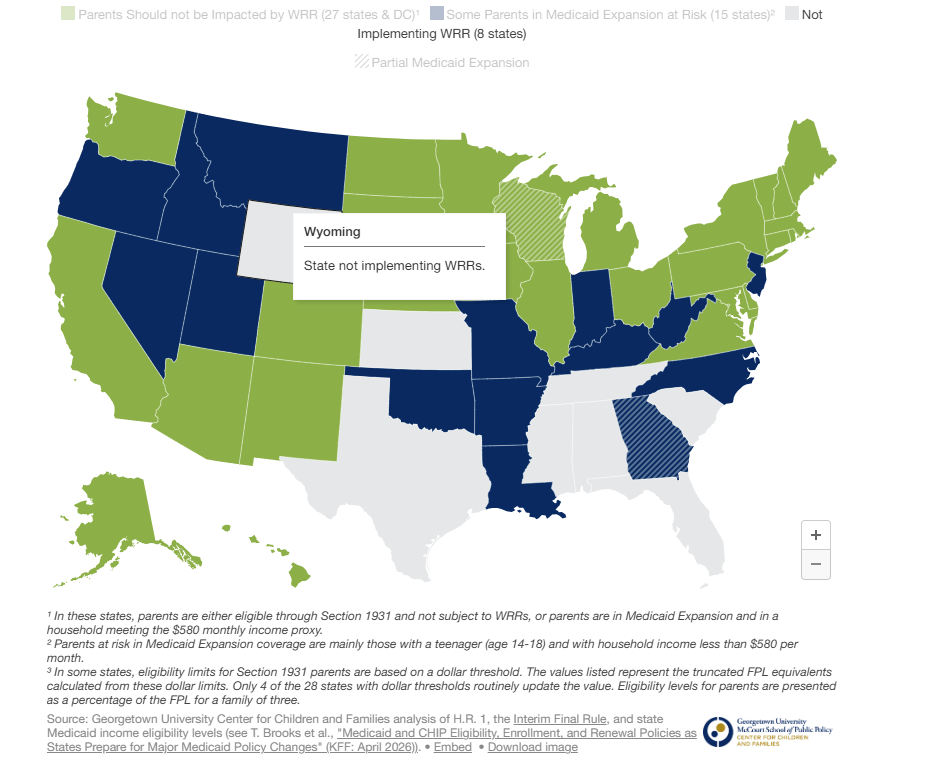
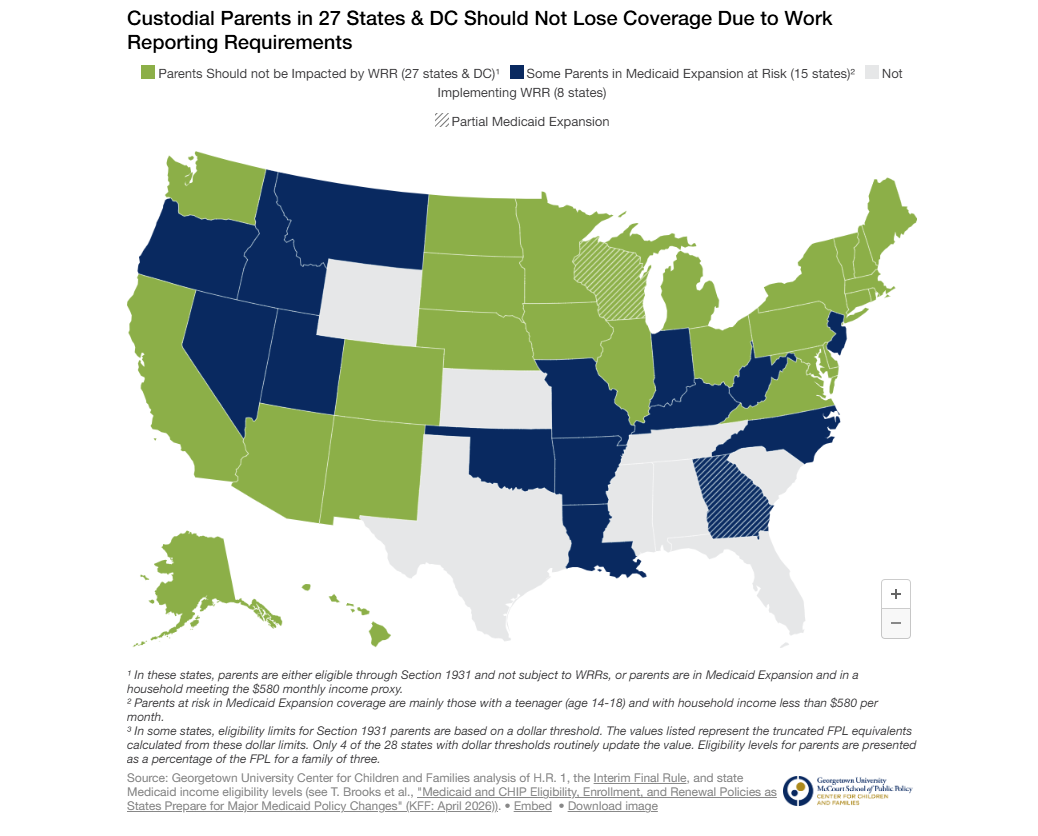
From this complex web of rules, there is a crucial takeaway for parents: The overwhelming majority of parents and caretaker relatives living with a child should not lose Medicaid coverage due to WRRs. In fact, in 27 states plus D.C., almost all custodial parents and caretaker relatives with a child should not be impacted by WRRs. In the remaining 15 states implementing WRRs, most custodial parents and caretaker relatives should not lose health coverage due to WRRs, however, a small subset with Medicaid expansion coverage are at risk if their household income is below $580 per month. This issue brief explains why.
Most parents with a child are protected from losing health coverage due to WRRs for one of three reasons:
The custodial parent or caretaker relative is not subject to WRRs at all because they are eligible for or enrolled in Section 1931 parent/caretaker relative Medicaid coverage, not Medicaid expansion;
The parent or caretaker relative is excluded from WRRs because they have a child age 13 or younger (one of the specific exclusions in H.R. 1); or
The parent’s household income is at least $580 per month so the adults in the household are determined compliant with WRRs (referred to as the $580 monthly income proxy).
State outreach materials must communicate clear messages to parents now, before implementation is in full swing, so that parents with children do not fall through the cracks. A recurring failure point of past WRR experiments is that most enrollees don’t know about the WRRs and whether they are impacted by them, much less the detailed processes for compliance. When Arkansas implemented WRRs in 2018, nearly half of the affected population said they were unsure whether the policy applied to them, and another third said they had heard nothing about it. Within two months of implementation, New Hampshire suspended its 2019 WRRs, in part due to a failure to reach affected enrollees. CMS has itself noted, in qualitative research conducted with Medicaid enrollees in April 2026, that many potential enrollees are unaware of work requirements and may have difficulty determining if they are affected under the new law, with uncertainty highest among those with caregiving responsibilities.
Custodial Parents in 27 States & DC Should Not Lose Coverage Due to Work Reporting Requirements
Three Reasons Parents with A Child Should Not Be Impacted by WRRs
Most parents and caretaker relatives with a child are protected from losing health coverage due to WRRs for one of three reasons.
Parents and caretaker relatives living with a child and enrolled in Section 1931 parent/caretaker relative Medicaid coverage are not subject to WRRs. WRRs are intended for adults ages 19-64 eligible for or enrolled in Medicaid through the Affordable Care Act’s (ACA) Medicaid Expansion (or enrolled in certain Section 1115(a)(2) waiver demonstrations, such as partial expansion programs in Georgia and Wisconsin). See CCF’s IFR Explainer for more details on the states and waiver demonstrations subject to WRRs. Individuals eligible for other Medicaid groups – such as pregnancy Medicaid coverage or Section 1931 parent/caretaker relative coverage – are not subject to WRRs.
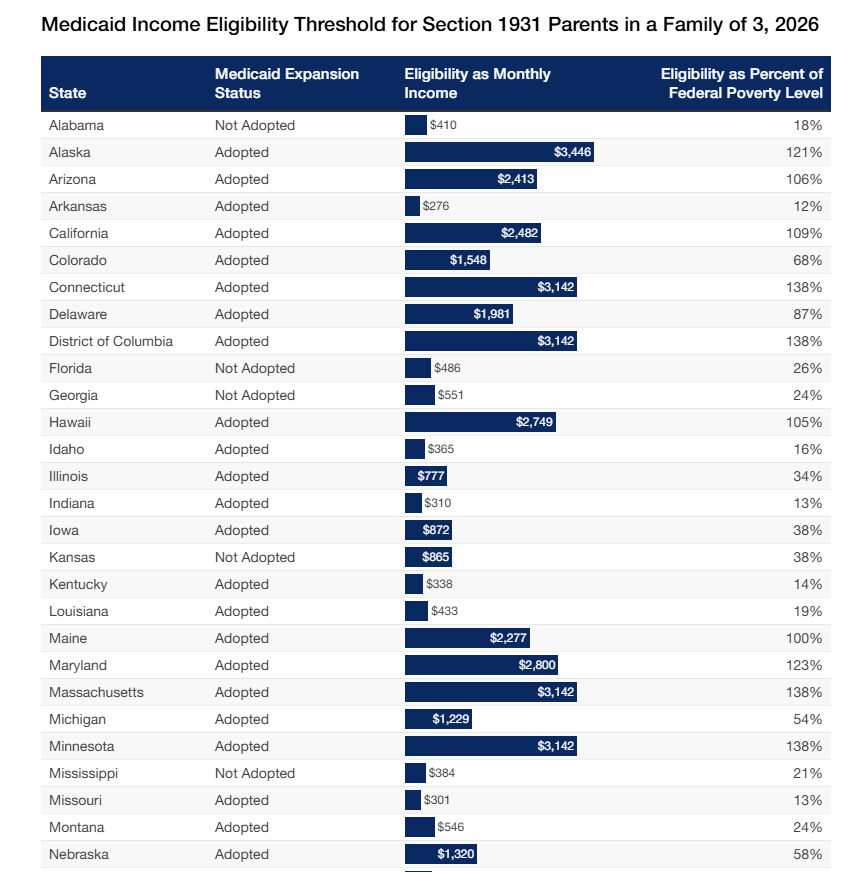
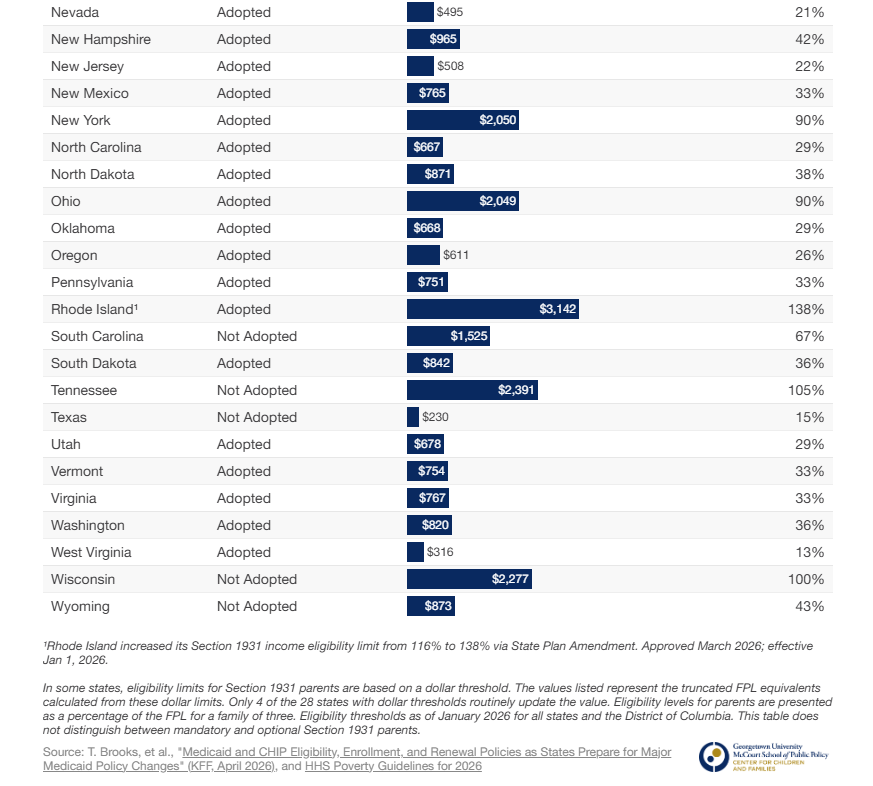
Income Limits: Section 1931 parent/caretaker Medicaid is a mandatory coverage group in all states dating from 1996. The minimum income eligibility level varies by state and is linked to a state’s income eligibility in 1988 for cash assistance, but many states have adopted higher levels. In 2026, the income limit for Section 1931 parent/caretaker coverage ranged from a low of 12% FPL family of 3 (making less than $270 per month) to a high of 138% FPL for a family of three (making less than $3,000 per month). The table below lists each state’s income eligibility limit for Section 1931 parent/caretaker relative coverage.
Non-Financial Requirements: For the 1931 coverage group, the parent or caretaker relative must live with and assume primary responsibility for a child under 18 or under 19, depending on the state. Defined at 42 CFR 435.4, caretaker relatives are related by blood, adoption, or marriage – such as a grandmother caring for her grandkids – as long as the relative lives with the child and assumes primary responsibility for the child’s care. Some states have added adults to the caretaker relative definition for purposes of Section 1931 coverage, such as half-blood relatives or a domestic partner of the parent or other caretaker relative.
Parents who are eligible for or enrolled in Medicaid expansion coverage (or an applicable waiver demonstration) and have a dependent child age 13 and younger are specifically excluded from WRRs. H.R. 1 and the IFR are very clear that parents, guardians, caretaker relatives, and family caregivers of a dependent child age 13 and younger or a disabled individual are specifically excluded from WRRs. For this exclusion, parents must provide “some level of care” but do not need to live with the child. Caretaker relatives must live with the child and assume primary responsibility for the child. Family caregivers may or may not need to live with the child, depending on the scenario. (See the final section of this brief for discussion of family caregivers. See CCF’s IFR Explainer here for more details on how each term is defined.) Adults must show they meet this parent/family caregiver exclusion in the month they apply for or renew Medicaid.
This WRR exclusion will be particularly important for parents who do not live with their child but still care for them. Noncustodial parents who do not live with the child would not qualify for Section 1931 Medicaid coverage but might be eligible for Medicaid expansion coverage if they have income under 138% FPL. Noncustodial parents may be excluded from WRRs if their child is age 13 or younger and they provide some level of care for the child.
Parents eligible for or enrolled in Medicaid expansion coverage (or an applicable waiver demonstration) with a child, regardless of the child’s age, should be automatically considered compliant with WRRs if their household income is at least $580 per month. In implementing WRRs, states must use an income proxy based on the federal minimum wage multiplied by 80 hours ($580 per month in 2026) to verify compliance with WRRs. States must first use data available to the state to automatically determine eligibility – including checking for WRR compliance or exclusions – before requesting additional information from applicants or enrollees (42 CFR 435.557(b)). This process of looking at existing, reliable data and data sources is called ex parte. (Learn more about ex parte data processes in CCF’s IFR Explainer here). The monthly income proxy is the most streamlined way for states to use ex parte data to verify income and compliance with WRRs.
The IFR makes an important clarification: states must use Modified Adjusted Gross Income (MAGI) household income to determine compliance with WRRs for all applicable adults in the family. This means that, if two adults in a family have a combined household income of $580 or above, then both adults in the household will be determined compliant with WRRs. (Learn more about MAGI income rules and how they apply to WRRs here.)
Under the IFR, states are expected to identify individuals who are specifically excluded from WRRs first and remove those adults from WRR compliance review. In theory, states would identify parents with children age 13 and younger first, before an assessment of the $580 income proxy. However, the reality might be different. CMS acknowledges that states are not required to change their existing procedures to implement a specific hierarchy when checking reliable information. States can – and likely will – pull eligibility data from all available data sources (e.g., income, family size, children’s ages) simultaneously, rather than sequentially, to verify compliance or exclusion. As a result, the $580 monthly income proxy will likely play a specific role for parents in Medicaid expansion whose youngest child is a teenager (age 14 to 18), as these parents do not fit into the WRR exclusion for parents with children age 13 and younger. But these parents with teens would still satisfy WRRs and not lose health coverage if they have a household monthly income of at least $580.
State-by-State Impact
The interaction between the $580 monthly income proxy and each state’s Section 1931 Medicaid income limit is key. A monthly household income of $580 translates to roughly 32% FPL for a family of two, 25% FPL for a family of three, 21% of FPL for a family of 4. Section 1931 income limits in each state range from 12% FPL to 138% FPL for a family of three. Of note, many states use dollar amount limits for Section 1931 income eligibility rather than percentage of the federal poverty level. The 12% to 138% FPL range represents the Section 1931 income limits for a family of three after the dollar amount threshold for a family of three is converted to the FPL equivalent. To see how parents and caretaker relatives in various household sizes would fare next to the $580 monthly income proxy, we identified the applicable Section 1931 income limits as dollar amounts for a family of two, family of three, family of four, and family of five. See appendix A for state-specific details, including each state’s Section 1931 income eligibility limits by household size and how it interacts with the $580 monthly income proxy.
Putting it all together, in states where the Section 1931 income limit is at or above 33% FPL for a family of three, parents with a child of any age should be largely protected. In states where the Section 1931 income limit is below 33% FPL for a family of three, a small subset of parents enrolled in Medicaid expansion are at risk. Here’s how this breaks down for the 43 states, including DC, implementing WRRs:
In 27 states and D.C., almost all custodial parents and caretaker relatives are either not subject to WRRs or compliant with WRRs. Because these states have a Section 1931 income limit at or above 33% FPL, parents and caretaker relatives with a child either qualify for Section 1931 Medicaid coverage or their household income meets the $580 monthly income proxy. The 27 states plus DC are: AK, AZ, CA, CO, CT, DC, DE, HI, IL, IA, MA, ME, MD, MI, MN, NE, NH, NM, NY, ND, OH, PA, RI, SD, VT, VA, WA, WI.
In six states – CT, DC, MA, MN, RI, and WI* – the Section 1931 Medicaid income limit is equal to the state’s Medicaid expansion eligibility level, meaning all or almost all custodial parents and caretaker relatives would be in Section 1931 Medicaid coverage and not subject to WRRs at all. (*WI operates a partial expansion waiver for adults up to 100% FPL.)
In the remaining 15 states implementing WRRs, most custodial parents and caretaker relatives should not be affected by WRRs, but a small subset will be. Because these states have very low Section 1931 income levels (at or below 32% FPL), parents and caretaker relatives at most risk would be those enrolled in Medicaid expansion whose youngest child is age 14-18 and whose household income falls below $580 per month. Unless they are exempt for another reason, these parents would have to report 80 hours per month of work, volunteering, or school enrollment when they apply and every six months at renewal to keep coverage. These 15 states are: AR, GA,* ID, IN, KY, LA, MO, MT, NV, NJ, NC, OK, OR, UT, WV. (*Georgia operates a partial expansion waiver for adults with income up to 100% FPL).
Family Caregivers Who are Not Custodial Parents Are Also Excluded from WRRs
If an adult caring for a child does not qualify as a parent or caretaker relative (for purposes of Medicaid eligibility and WRR rules), they may still be considered a family caregiver and excluded from WRRs, depending on the scenario.
In H.R. 1, Congress set out several categories of individuals who are specifically excluded from WRRs, including “parents, guardians, caretaker relatives, and family caregivers…of a dependent child 13 years of age and under or a disabled individual” (Social Security Act Section 1902(xx)(9)(A)(ii)(III)). While terms like parent and caretaker relative already exist in Medicaid law, other terms, such as “family caregiver” have not been defined previously for Medicaid policy. Under the IFR, family caregiver is defined broadly to include an adult family member or other individual who has a significant relationship with, and who provides care within a broad range of assistance to, a dependent child age 13 or younger or a disabled individual (42 CFR 435.554(a)). The IFR further describes what constitutes a “significant relationship” between caregiver and care recipient, outlining three scenarios that potentially cover a broad swath of caregiving arrangements: living with the care recipient and providing regular care; related to the care recipient and providing regular care; or unrelated, not living with the care recipient but providing at least 80 hours of care per month. See CCF’s IFR Explainer here for more details on the family caregiver WRR exclusion.
In adding family caregiver to the list of individuals specifically excluded from WRRs, the law recognizes the wide range of caregiving scenarios that characterize family life across America. Family caregiver exclusion applies to an individual who gives regular assistance to their disabled parents; an aunt who does not live with her niece but cares for her during the day (the aunt is not a caretaker relative because she does not assume primary responsibility for the child); and home-based child care providers who are the backbone of many communities and care for over 7 million children from birth to 5 years old, including 30 percent of infants. Ultimately, the exclusion might apply to familial or nonfamilial caregiving, paid or unpaid caregivers, and arrangements in which the adult may or may not live with the child age 13 or younger (or disabled individual).
However, it may be much more difficult for adults to show they are a family caregiver excluded from WRRs – and for states to verify them. States already have experience verifying parents and caretaker relatives for purposes of Section 1931 Medicaid coverage; but application of family caregivers is new. In the IFR, CMS acknowledges that, because of the personal nature of family caregiving, such as regular assistance to disabled parents, “there will be circumstances in which no documentation exists, or documentation is not reasonably available” (91 Fed. Reg. 33395). Sworn attestation, which occurs under penalty of perjury, remains the best way to verify eligibility for the family caregiver exclusion. Official paperwork – such as pay stubs, employer/employee contracts, time sheets, or tax documents – simply does not exist in many caregiving relationships. But, starting in 2028, states must require documentation whenever it is reasonably available. If documentation is not reasonably available, the state must establish a process for accepting information sufficient to verify the exclusion. To avoid substantial confusion, it will be important for stakeholders to work with state Medicaid officials to identify a user-friendly, efficient process for family caregivers to demonstrate they meet this exclusion.
Additional CCF Resources
New Federal Medicaid Work Reporting Requirements Rule Threatens Coverage for vulnerable Americans: An Explainer of the interim Final Rule
Tracking Implementation of H.R. 1 Work Reporting Requirements, including state-specific pages