By Adriana Kohler and Jade Little / November 5, 2026
State-level decisions are shaping how Medicaid work reporting requirements (WRRs) affect people who rely on Medicaid coverage. This week, we focus on state policy choices for adopting the short-term hardship exception.
States may adopt a short-term hardship exception that gives an applicant or enrollee in Medicaid expansion coverage a temporary reprieve from demonstrating WRR compliance. The four short-term hardship events are for: individuals living in a county with high unemployment; those living in a county with a federally-declared disaster or emergency; individuals admitted to a hospital (or similar) facility; or those who must travel outside their area for medical care. The CMS Interim Final Rule (IFR) clarifies that, if a state elects the short-term hardship exception, it must adopt all four hardship events.
Although states may not pick and choose which hardship events to adopt, they are not required to “effectuate” the high unemployment hardship exception even if conditions are present in the state. KFF’s local high unemployment map shows which counties meet the high unemployment threshold under the IFR. States must seek CMS approval to effectuate the high unemployment hardship exception. Separately, the state must notify CMS of its plan to activate the disaster or emergency hardship exceptions when a disaster/emergency is federally declared. Read more about the four short-term hardship events in CCF’s IFR Explainer.
Based on information that state Medicaid officials reported as part of the annual KFF/CCF survey related to eligibility, enrollment, and renewal policies, most states plan to adopt the short-term hardship exception. But, the national KFF/CCF survey was fielded in February 2026, before the IFR clarified that states electing the short-term exception must adopt all four hardship events. Several states had not made a decision at the time of the survey.
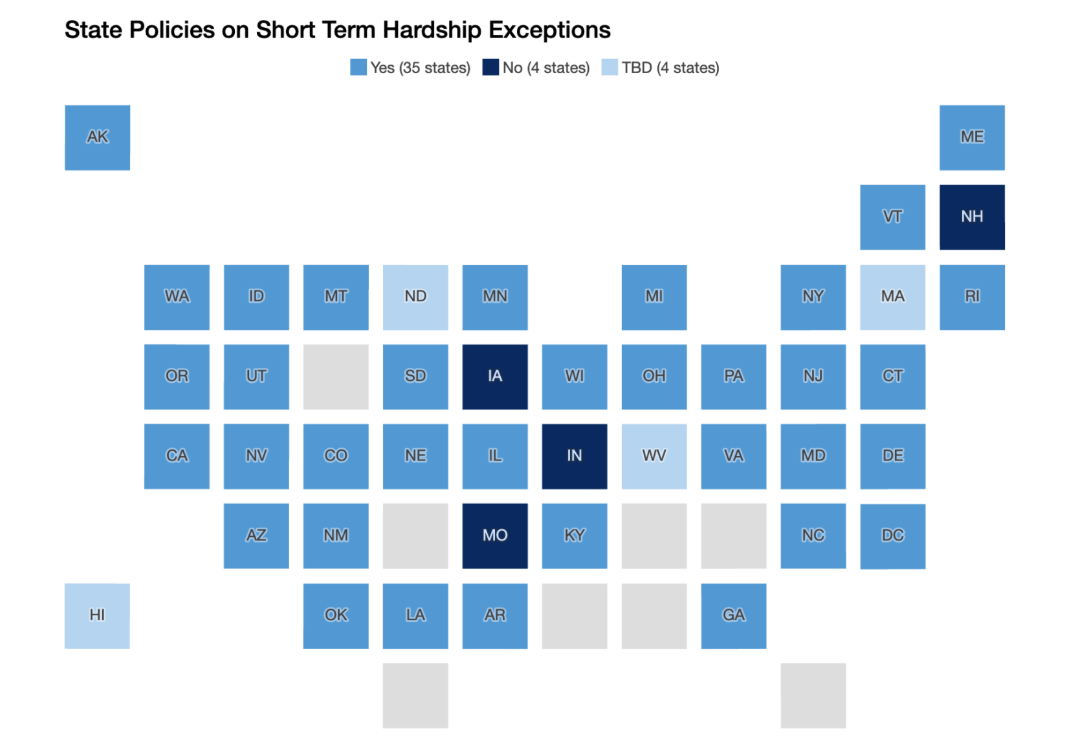
Since the release of the KFF/CCF national survey, states have announced their decisions on their state Medicaid websites. In the coming months, states will confirm their selection via a Medicaid State Plan Amendment, which states must submit to CMS to describe their plans and processes for implementing WRRs. See Table below and for the list of state decisions and links to sources.
Missouri announced in October 2026 that, while it initially planned to adopt the short-term hardship exceptions, it will not adopt the short-term exception for any of the hardship events.
Colorado announced during a recent MACPAC meeting that the state plans to adopt the short term hardship exception later in 2027, but it will not be in place at “go live” because they ran out of capacity and time prior to the law’s effective date.
Two states (New Hampshire and Indiana) passed state laws barring or greatly restricting use of the short-term hardship exception. Indiana’s law completely bars the state from adopting the short-term hardship exception, while New Hampshire requires approval from an oversight committee before the state may elect to offer short-term hardship exceptions. Restricting short-term hardships limits a state Medicaid agency’s ability to respond to real-world situations, such as floods, wildfires, hurricanes or the closure of major employers in an area.
Nebraska is the first state to start activating the disaster, emergency, and high unemployment short-term hardship exception events. Nebraska, which launched WRRs on May 1, received CMS approval for its Medicaid State Plan Amendment indicating it will adopt all four short-term hardship exception events. The state has put in place three short-term hardship exceptions in 14 counties, although they apply to different months.