
Medicaid Maternity Care Payment Reform: Overview of State Value-Based Models
By Anna Lipton Galbraith / September 14, 2026
Overview and Background
States are increasingly using or considering maternity-specific value-based payment (VBP) arrangements in Medicaid to manage health care costs, strengthen care quality, and improve perinatal health outcomes. Many state perinatal health systems are facing high and increasing costs for maternity care services, particularly for high-risk pregnancies and deliveries with maternal or neonatal complications.
At the same time, states are grappling with the impact of a growth in obstetrics unit closures in recent years. These closures, often related in part to the cost of operating hospital obstetrics units, can result in longer travel distances to care and delayed or reduces prenatal care.
Many states are implementing maternity care payment strategies to incentivize preventive services and care coordination, discourage unnecessary or low-value care, and control the total cost of maternity care in Medicaid.
State Medicaid payment strategies for maternity care include targeted payment incentives for providers to deliver specific services (such as notification of pregnancy, risk-screening, referrals, postpartum visit), inclusion of perinatal quality measures in broad state VBP initiatives (such as timeliness of prenatal and postpartum care), and comprehensive maternity-specific VBP models that provide shared savings and sometimes risk-sharing for maternity care providers associated with the total cost of care, care quality, and patient outcomes.
Key Takeaways
At least ten states have implemented maternity care VBP models in Medicaid that prioritize early risk identification, preventive services, and improving maternal and neonatal outcomes to manage costs and strengthen health care quality and outcomes.
Episode of care models are the most common VBP approach used for maternity care, with most of these models leveraging ‘bonus’ or up-side payment arrangements to encourage provider participation without imposing significant financial risks.
The quality measures tied to payment in states’ maternity care VBP models include a strong focus on screening for perinatal risk factors, preventive care services, and labor and delivery outcomes.
Maternity Care VBP Models
Episodes of Care (EOC): A primary provider, typically the physician responsible for delivery, is accountable for the cost and quality of a defined set of perinatal services. The accountable provider may experience shared savings for meeting cost and quality benchmarks and be responsible for making payments when costs exceed the benchmark.
Pay for Performance (P4P): Providers delivering perinatal care are eligible for shared savings payments for meeting cost and/or quality benchmarks. Providers may be required to make risk-sharing penalty payments if costs exceed benchmarks.
Pregnancy medical homes (PMH): Providers are eligible to receive bonus payments for delivering a defined set of services and/or meeting quality metrics, typically focused on patient engagement, risk screening, care coordination, and population health.
State Value-Based Payment Models for Maternity Care in Medicaid
To support states’ ongoing efforts to develop and refine maternity care payment strategies, this brief synthesizes analyses of state maternity care VBP models in Medicaid. The brief is informed by a scan of all 50 states, which identified ten states with current or recently sunset maternity care VBP models (Arkansas, Colorado, Connecticut, New Jersey, New York, North Carolina, Ohio, Pennsylvania, Tennessee, Wisconsin). Five of the identified states have implemented a maternity care VBP model for over a decade (Arkansas1, Connecticut, North Carolina, Tennessee, and Wisconsin), including EOC, P4P, and PMH models. An additional five states were identified that began implementing a new maternity care VBP model between 2018 and 2025, including all three VBP model types (Colorado, New Jersey, New York, Ohio, and Pennsylvania).
In addition to efforts in these states, states may be considering maternity care payment reforms in the context of the current perinatal care landscape and proposed changes to the Current Procedural Terminology (CPT®) codes for maternity care services (see “Updates to Maternity Care Billing and Reimbursement”). Concurrently, 15 states are developing or updating existing maternity care VBP models under the Centers for Medicare and Medicaid Services (CMS) Innovation Center’s Transforming Maternal Health model (TMaH).
Updates to Maternity Care Billing and Reimbursement
Providers have historically billed Medicaid for maternity care using one of two Current Procedural Terminology (CPT®) codes for the global obstetric packages (59400-vaginal delivery, 59510-cesarean delivery). Effective January 1, 2027, these global CPT codes will be eliminated, transitioning maternity care billing to individualized service-level codes. These CPT code changes will likely have implications for maternity-specific VBP models.
State Approaches to VBP for Maternity Care At-a-Glance
Ten states were identified with current or recently sunset maternity-specific VBP models (AR, CO, CT, NJ, NY, NC, OH, PA, TN, WI).
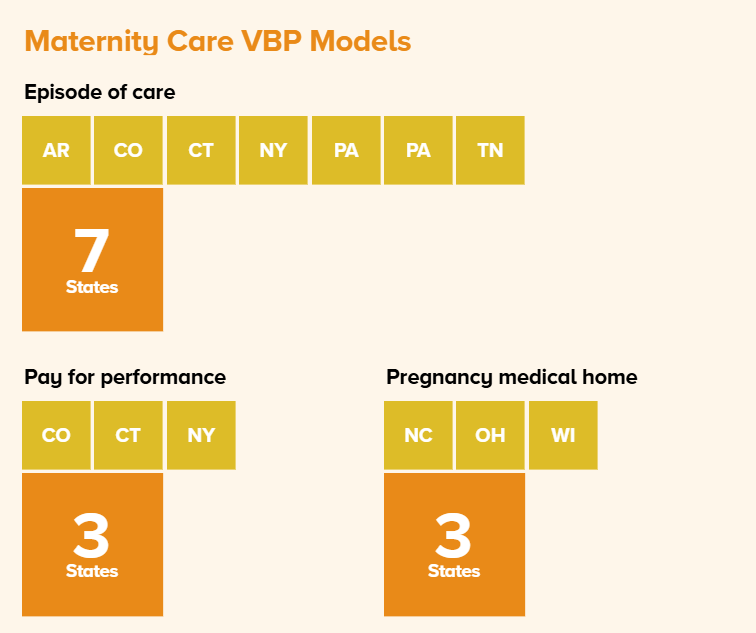
Seven states are using an EOC model (AR, CO, CT, NY, PA, TN, NJ), three states with EOC models are also implementing P4P models (CO, CT, and NY), and three states are using PMH models (NC, OH, WI).
Eight states use upside-only shared savings arrangements, in which providers are eligible for bonus payments but do not take on financial risk by participating (CO, CT, NJ, NY, NC, OH, PA, and WI). Two states have implemented two-sided risk arrangements, in which providers are eligible for bonus payments and are also subject to risk penalties (AR and TN). New York allows MCOs to enter one-sided or two-sided payment arrangements with providers under the voluntary EOC model.
The quality measures tied to payment in states’ maternity care VBP models include a strong focus on screening for perinatal risk factors, preventive care services, and labor and delivery outcomes.
Of the ten states that have implemented maternity-specific VBP models, three states are also participating in TMaH (AR, NJ, and WI).
What types of maternity care VBP models are states implementing in Medicaid?
Eight states with maternity-specific VBP arrangements in Medicaid are using an EOC model, which allows a primary provider to realize shared-savings associated with the cost and quality of perinatal services (Colorado, Connecticut, New Jersey, New York, North Carolina, Ohio, Pennsylvania, and Wisconsin). Three states implementing EOC models are also implementing a P4P model (Colorado, Connecticut, and New York). Three states are implementing a PMH model, in which providers are eligible to receive incentive payments for delivering a defined set of services and/or meeting quality metrics (North Carolina, Ohio, Wisconsin). Two of these PMH models, North Carolina and Wisconsin, have been in place since 2011 and are the longest running maternity care specific VBP models.
Pennsylvania’s Maternity Care Bundle (EOC model) provides shared savings for maternity care teams if their fee-for-service payments for the service bundle are below the target price set by the managed care organization (MCO). The state’s managed care contract details the maternity care team composition, methodology for determining services in the bundle and establishing the target price, and quality measures used to determine the incentive payment. See the appendix for specific information on the maternity care teams, including composition and requirements.
Colorado is implementing both an EOC model for obstetric providers who deliver prenatal services (Maternity Care Bundled Payments) and a P4P model for hospitals serving pregnant women enrolled in Medicaid (Hospital Quality Improvement Program(HQIP)). Under HQIP, participating hospitals are eligible for bonus payments based on twelve quality measures in three domains: maternal health and perinatal care, patient safety, and patient experience.
Ohio’s Comprehensive Maternal Care Model(PMH model) is voluntary for obstetrical practices enrolled in Medicaid across a range of settings (e.g., clinics, hospitals, FQHCs). Participating providers receive quarterly prospective per member per month payments for completing nine required population health activities and 50 percent of the applicable clinical quality metrics, in addition to claims payments for obstetrical services. Providers may also qualify for additional quality improvement bonus payments paid at the end of the program year.
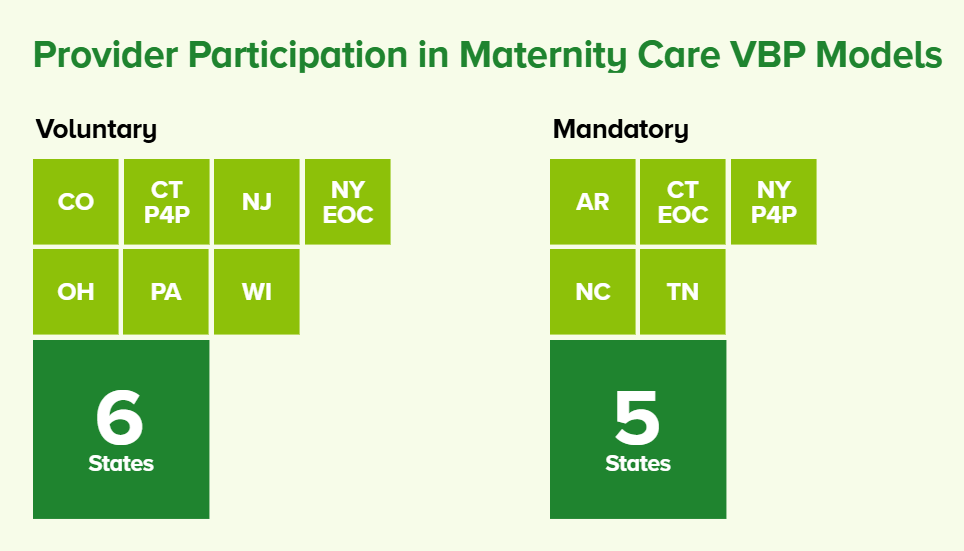
States’ maternity care VBP models vary in terms of provider eligibility, whether participation is voluntary or mandatory for eligible providers, and which pregnant women are included in the shared savings methodology. Models may include obstetricians, family medicine physicians, licensed midwife practices, and additional providers supporting perinatal care (e.g., physicians assistants, nurse practitioner) as eligible for participation. These providers are sometimes required to meet a minimum number of episodes/deliveries to be eligible for shared savings, ranging from 15 to 30 per performance period.
Most state maternity care VBP models include all pregnant women who are enrolled in Medicaid and meet the requirements for attribution to a participating provider, with limited exclusions. However, Wisconsin’s Obstetric Medical Home Initiative is limited to pregnant women who have been identified as high-risk for a poor birth outcome.
What type of shared savings model are states using for maternity care VBP?
Most states with maternity-specific VBP models use upside-only shared savings arrangements, in which providers are eligible for gainsharing (retrospective bonus payments) when the average costs of care are below the established cost threshold and quality metrics are met (Colorado, Connecticut, New Jersey, New York P4P, North Carolina, Ohio, Pennsylvania, and Wisconsin). These upside-only shared savings arrangements are designed to support provider participation in the payment model without risk of financial penalty if spending exceeds the established cost threshold. Two states (Arkansas and Tennessee) have implemented two-sided risk arrangements, in which providers are eligible for gainsharing when average costs are below the established cost threshold and are also subject to risk penalties when average costs exceed the threshold. New York allows MCOs to enter one-sided or two-sided payment arrangements with providers under the voluntary EOC model.
Tennessee’s Perinatal EOC Model provides a retrospective payment adjustment for providers based on cost and performance on quality metrics. Gainsharing payments and risk-sharing penalties are 50 percent of the difference between the established cost threshold and average costs, multiplied by the number of episodes during the performance period. Total gainsharing is limited by a threshold set by the state and MCOs.
In EOC models, states’ shared savings payment methodologies typically reflect the difference between actual average costs and the established cost thresholds (e.g., 50 percent of net savings) and the number of pregnant women served. EOC models may also include payment weighting based on provider performance on quality metrics. Most states establish a universal threshold that providers need to meet to realize shared savings. This shared savings structure allows participating providers to realize a portion of the cost savings associated with delivering higher value perinatal care. However, New Jersey benchmarks cost thresholds for providers based on their previous performance, requiring a 3 percent reduction in risk-adjusted episode spend to be eligible for shared savings. In Pennsylvania, MCOs develop the target price for their contracted providers based on historical spending and accounting for acuity.
In P4P and PMH models, providers are eligible for bonus payments for completing specific activities, meeting quality measures, and may be held accountable for labor and delivery outcomes. The current P4P (Colorado and Connecticut) and PMH models (North Carolina, Ohio, and Wisconsin) do not include financial risk for participating providers who do not meet the model requirements.
North Carolina’s Pregnancy Management Program (PMH model) pays, at a minimum, the same rate for vaginal deliveries as caesarian sections. Providers also receive $50 for completing a high-risk screening and $150 for completion of the postpartum visit.
What quality measures are tied to payment in maternity care VBP models?
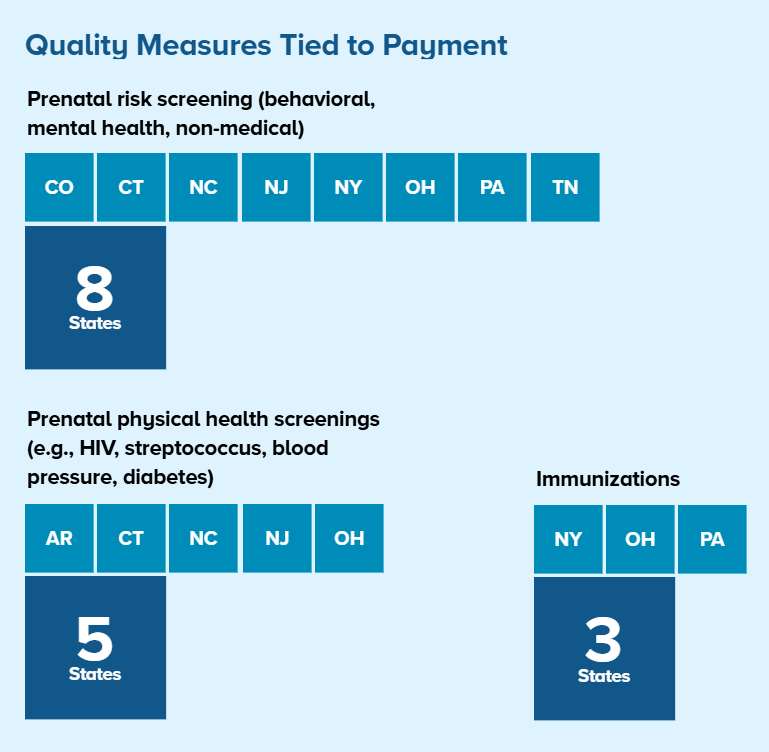
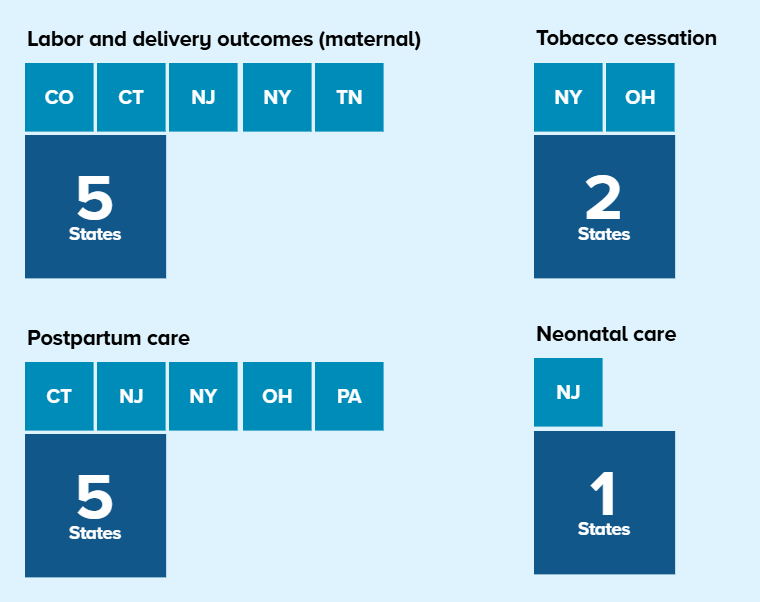
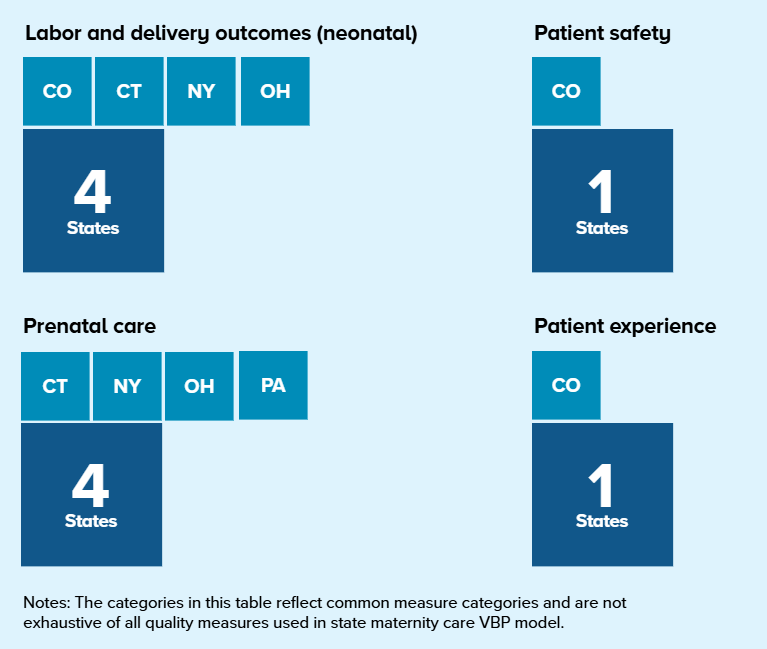
The quality measures tied to payment in states’ maternity care VBP models include a strong focus on screening for perinatal risk factors, preventive care services, and labor and delivery outcomes. Eight states’ payment models include measures related to prenatal risk screenings, including screenings for physical, behavioral, mental health risk factors, as well as for non-medical risk factors (Arkansas, Colorado, Connecticut, New Jersey, New York, Ohio, Pennsylvania, Tennessee). Six states’ models include payment measures related to labor and delivery outcomes, including both maternal and neonatal outcomes (Colorado, Connecticut, Ohio, New Jersey, New York, Tennessee). States also include payment measures related to delivery of prenatal care (Connecticut, New York, Ohio, Pennsylvania) and postpartum care (Connecticut, New Jersey, New York, Ohio, Pennsylvania). Colorado’s HQIP program is focused on hospital quality and includes quality measures related to patient safety and experience. Some states, including Arkansas, Colorado, and Connecticut include additional pay for reporting measures in their quality measure sets.
Endnotes
1 Arkansas’ Perinatal Episode of Care model began in 2012 and was sunset in 2021.
2 In the Pennsylvania Maternity Care Bundle, the maternity care team must include a clinician qualified to provide maternity care, a clinician qualified to assist with vaginal deliveries and cesarean deliveries, a clinician licensed to provide newborn services, a physician qualified to treat high-risk pregnancies, a hospital qualified to perform cesarean deliveries and treat common labor and delivery complications, anesthesiology practice, practice or hospital that can perform lab tests, care coordinator, doula, and community health worker. A single individual can fulfill multiple roles.
Conclusion
State Medicaid programs are actively testing maternity-specific VBP models that prioritize early risk identification, preventive services, and improving maternal and neonatal outcomes to manage costs and strengthen care quality. To date, most states with maternity-specific VBP are implementing EOC models with upside-only payment arrangements to encourage provider participation without imposing significant financial risks. As states continue to refine these models, including in the context of TMaH and upcoming CPT coding change, there is an ongoing opportunity to align payment with delivery of high-value and high-quality perinatal care.