
By Yuliya Yafimenka and Edwin Park / November 9, 2026
We have been tracking the troubling declines in child enrollment in Medicaid and the Children’s Health Insurance Program (CHIP). According to our latest data through August 2026, the number of children enrolled in Medicaid and CHIP has fallen by 2.56 million across all states since January 2025, according to state administrative data and data reported by states to the Centers for Medicare and Medicaid Services (CMS).
However, millions of children in low-income families have been losing food assistance as well. The Center on Budget and Policy Priorities (CBPP) has been similarly tracking child enrollment in SNAP where state administrative data are available. Across 26 states, about 1.6 million fewer children were enrolled in SNAP benefits in May 2026 compared to enrollment levels in those states in January 2025. That is a drop of 15.7%. Over this same period of time (January 2025 through May 2026), about 1.5 million fewer children were enrolled in Medicaid and CHIP in these 26 states, a drop of 6.3%.1 While the numerical declines look similar, child SNAP enrollment is shrinking about 2.5 times faster than child Medicaid/CHIP enrollment, with the gap widening sharply after Congress enacted H.R. 1 in July 2025 (which includes not just the largest Medicaid cuts in history but also the largest SNAP cuts in history).
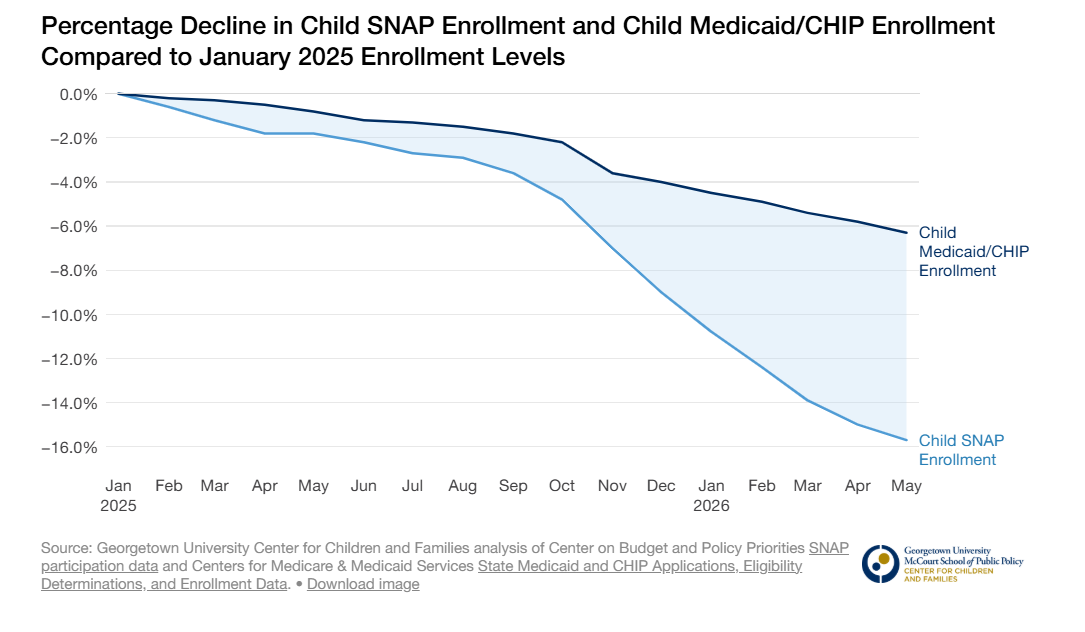
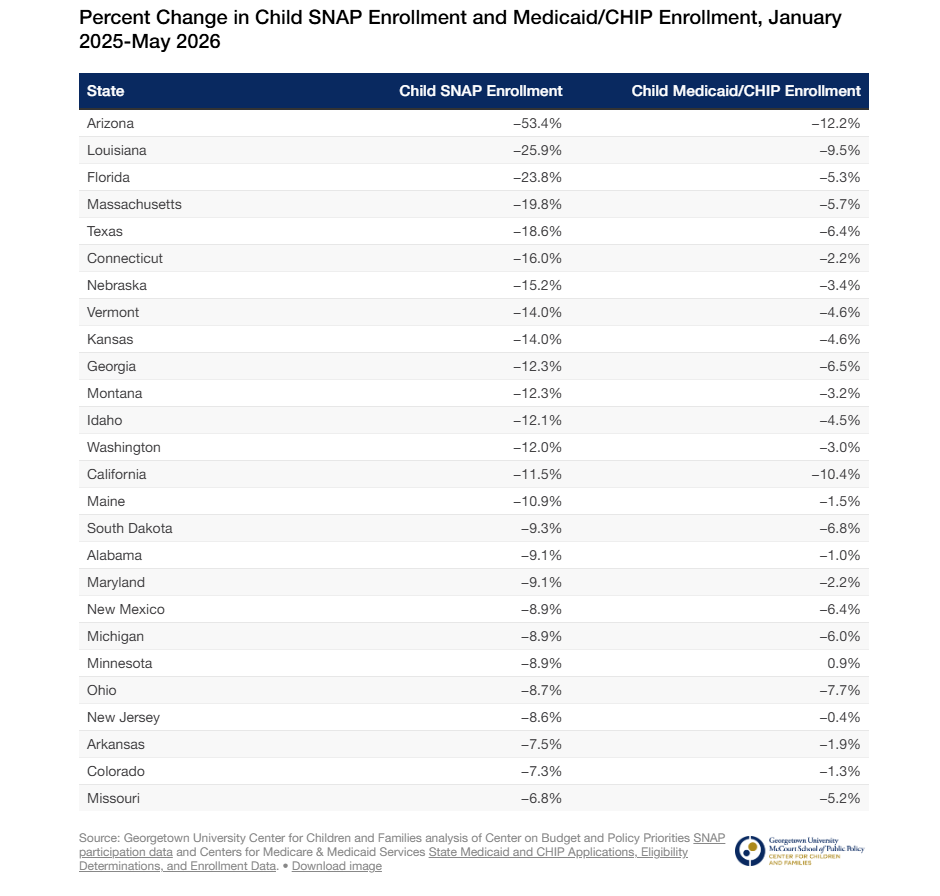
As seen in the above table, for the first half of 2025, child enrollment in both programs drifted down slowly and roughly in parallel. By September, child SNAP participation was down 3.6% and child Medicaid/CHIP enrollment about 1.8%. From fall 2025 on, child SNAP participation fell much more rapidly than child Medicaid/CHIP enrollment. The pattern is similar across very different states. Arizona lost half of its children on SNAP between January 2025 and May 2026, while its Medicaid/CHIP enrollment fell 12.2%. Louisiana, Florida, Massachusetts and Texas lost between 19%-26% of their children on SNAP, compared to child Medicaid/CHIP enrollment declines in those states of roughly 5-10%.
We have previously written about some of the factors that may be contributing to the child Medicaid/CHIP enrollment declines even though the major Medicaid cuts in H.R. 1 are just starting to take effect (such as the eligibility restrictions affecting lawfully present immigrants as of October 1, 2026 and the work reporting requirements taking effect on January 1, 2027). These include: more red tape and less outreach to families, the Trump Administration’s lack of enforcement of federal protections for children’s coverage, confusion about whether work reporting requirements and other cuts to Medicaid are already being enacted, and a chilling effect among mixed-status families who are fearful of enrolling or renewing citizen children in public coverage. The larger and more rapid SNAP enrollment declines appear to be due, in large part, to the fact that H.R. 1’s SNAP cuts are already in effect and causing children to lose needed nutrition assistance.
These H.R. 1 policy changes include tightening existing SNAP work reporting requirements (and related time limit penalties) for parents and other caregivers of children ages 14 and older, which took effect in fall 2025. Moreover, for the first time (starting in October 2027) H.R. 1 requires states to pay 5% to 15% of SNAP benefit costs depending on their payment error rates. (The federal government currently picks up 100% of SNAP benefit costs.) Because the state share of SNAP benefits costs is based on prior error rates, this created financial incentives for states to immediately impose much more overall red tape in their SNAP eligibility and enrollment process to prioritize avoiding any potential errors over delaying or wrongly denying an eligible family. Finally, as of October 2026, H.R. 1 also cut federal funding for program administration (requiring states to pick up 75% of SNAP administrative costs up from 50%), with states already experiencing eligibility staffing shortages and backlogs. That means even more families will likely lose benefits over missed paperwork and an overwhelmed eligibility system.
Although children are not directly subject to the harsher work reporting requirements, in the states CBPP tracks, children make up about 42% of those who have lost SNAP since July 2025 (about 1.5 million children) suggesting whole families are being cut off, not just their parents. Georgetown CCF has dubbed this the “unwelcome mat” effect and it is likely a harbinger of what will happen when Medicaid work reporting requirements are in full swing. History shows that when parents lose Medicaid coverage, their eligible children are likely to be disenrolled and become uninsured too. The connection between SNAP and Medicaid eligibility systems in many states makes it even more important for states to focus attention on preventing eligible children from losing both Medicaid and SNAP due to red tape and other barriers. The KFF-CFF eligibility and enrollment survey shows that half of the expansion states subject to the work reporting requirements use an integrated eligibility system for both Medicaid and SNAP. In addition, a small number of expansion states have adopted the Express Lane Eligibility option to directly rely on SNAP eligibility findings to facilitate eligible children’s enrollment in Medicaid.
For now, child Medicaid/CHIP enrollment may be holding up better than SNAP’s participation in part due to the 12-month Medicaid/CHIP continuous eligibility requirement applying to all states put in place on January 1, 2024. States are required to keep children under 19 enrolled in Medicaid and CHIP for a full 12 months once they qualify, similar to how private health insurance works. SNAP doesn’t have this kind of protection which means a family’s benefits can end at any recertification or required check-in. For children, that means a missed form can cut off food assistance within months, while their health coverage stays in place until the next annual renewal. But as the most damaging Medicaid cuts in H.R. 1 continue to take effect, such as work reporting requirements and 6-month renewals that affect parents enrolled through the Medicaid expansion, it is likely that the declines in child Medicaid/CHIP enrollment will also begin to accelerate rapidly. These effects will be further worsened as states institute substantial Medicaid budget cuts for the upcoming state fiscal year that will affect children’s coverage and access in response to the sizable cost-shifts expansion states will face under the provider tax restrictions that take effect in October 2027. As a result, millions of children in low-income families face the devastating loss of both essential health coverage and food assistance in coming months and years.
We analyzed monthly child SNAP participation and Medicaid/CHIP enrollment for 26 states with complete, comparable data for both SNAP and Medicaid/CHIP, January 2025 to May 2026. The states in the analysis are Alabama, Arizona, Arkansas, California, Colorado, Connecticut, Florida, Georgia, Idaho, Kansas, Louisiana, Maine, Maryland, Massachusetts, Michigan, Minnesota, Missouri, Montana, Nebraska, New Jersey, New Mexico, Ohio, South Dakota, Texas, Washington, and Vermont. Pennsylvania and New Hampshire are excluded because their SNAP data begin in June 2025. Ohio’s October 2025 SNAP figure is unusually low and CBPP treats it as misreported so we have smoothed out Ohio’s data. Figures are state totals, not matched children. Child SNAP participation data in this analysis are data available as of October 23, 2026 and child Medicaid/CHIP enrollment data are data available as of October 30, 2026.