
Which States Are Seeing the Largest Declines in Child Medicaid/CHIP Enrollment?
By Joan Alker / June 10, 2026
Georgetown CCF has been closely monitoring Medicaid/CHIP enrollment for many years — especially during periods of rapid change. Unfortunately, we are in another period where large declines in child Medicaid/CHIP enrollment are happening—more than 2 million fewer children are enrolled since January 2025. Why is this bad news? Because children in working families don’t have other obvious sources of affordable, comprehensive health coverage.
The critical question, of course, is whether those kids will find alternative coverage or become uninsured. We will find out more about the answer to this question this fall when the U.S. Census Bureau releases American Community Survey data for 2025, and we conduct our annual analysis of child coverage rates. Historically, when child enrollment in Medicaid and CHIP declines, child uninsured rates rise – which is precisely why we are so worried by such large enrollment declines. So for now, let’s unpack what we’re seeing when it comes to child enrollment in Medicaid. Here’s the short story: it doesn’t look good.
Which states are seeing the largest declines in child Medicaid/CHIP enrollment?
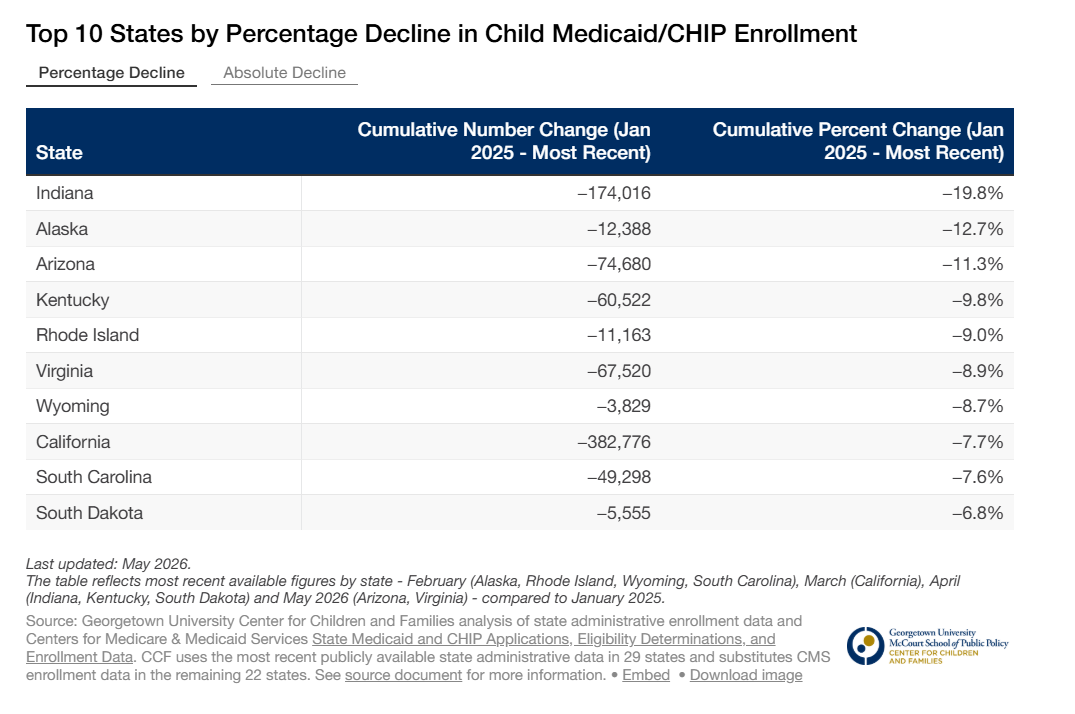
Indiana is at the top of the list in terms of percentage declines with an enrollment decline of 19.8% (or over 174,000 children) in April 2026 compared to January 2025. Indiana passed a state law in 2025 that added additional red tape and reporting requirements, which is likely contributing to the declines.
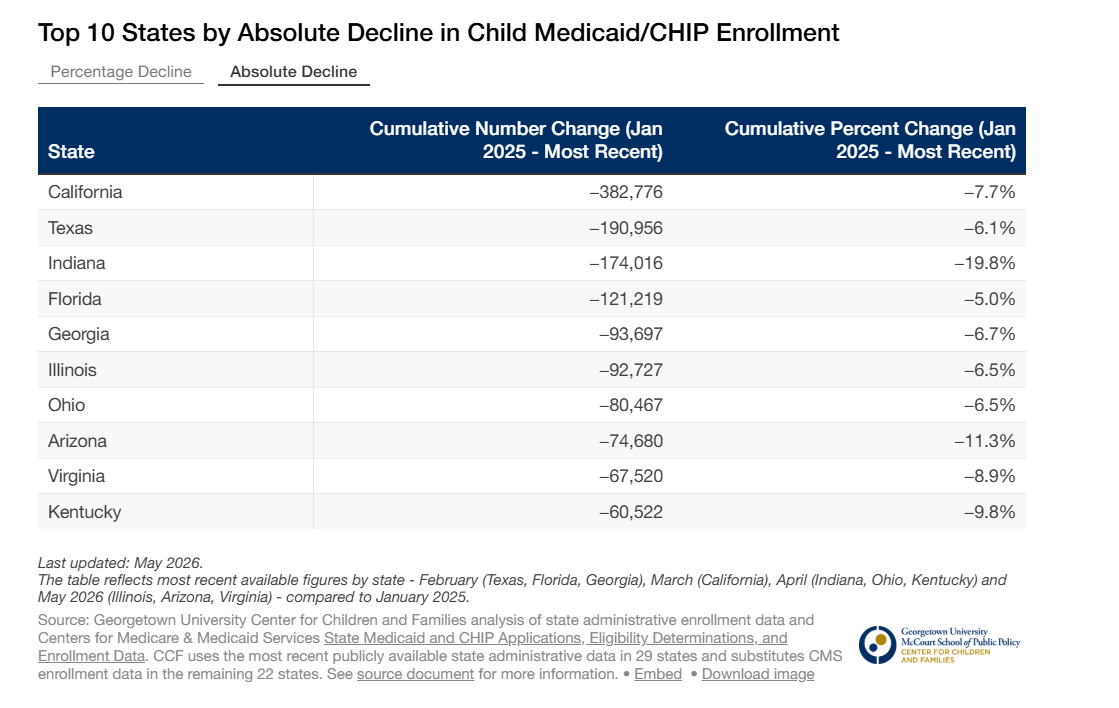
California is among the leaders of declining child enrollment in terms of absolute numbers – the child enrollment declined by over 382,000 (7.7%) kids by March 2026 as compared to January 2025. The top ten states experiencing the largest absolute declines in child Medicaid/CHIP enrollment (California, Texas, Indiana, Florida, Georgia, Illinois, Ohio, Arizona, Virginia and Kentucky) accounted for 67% of enrollment losses. The geographic and political diversity of these states underscores that this is a widespread problem. Only two states are holding steady or showing a slight increase (Colorado and Minnesota).
As we have repeatedly emphasized, these enrollment losses are occurring BEFORE Medicaid cuts associated with H.R. 1 are coming into play, which is alarming as more declines will be on the way. Child enrollment declines are happening ON TOP of very large reductions in child enrollment that occurred during the post-pandemic “unwinding” – which we also closely monitored – and led to an increase in the child uninsured rate from 5.1% in 1022 to 6% in 2024. As we expected, the pattern during the unwinding was different for children as opposed to adults for whom post pandemic enrollment declines did not result in a similar rise in the uninsured rate – a point often overlooked in the public discourse. That is because the majority of uninsured children are often eligible for Medicaid or CHIP but not currently enrolled or have lost coverage at renewal.
So why are these enrollment declines happening? In addition to state specific legislative changes such as those that occurred in Indiana that doubled down on some of the national trends, our best guesses (based on past experience) are:
The anti-immigrant agenda of the Trump Administration (including an unprecedented sharing of Medicaid data with ICE) is creating a “chilling effect” whereby the parents of citizen children are fearful to enroll their clearly eligible children because of possible negative consequences for other family members such as deportation. The “chilling effect” is well documented in research and indeed was acknowledged and cited by the Trump Administration (albeit in a flawed way) itself in its proposed regulatory changes to the public charge rule.3 In addition some states (including Indiana) are passing harsh state laws about reporting the immigration status of family members to the federal government.
More red tape and less outreach assistance to help families overcome administrative barriers. Cuts to navigator funding undermine access to enrollment support for families struggling to access affordable health coverage. The Trump Administration announced a 90% funding cut to the Affordable Care Act’s Navigator program that provides crucial outreach and enrollment support, especially in rural areas where brokers may not operate. The funding accounts for 5% of user fee dollars, so the cuts are unlikely to generate promised premium savings and may raise them by weakening the overall risk pool. Research shows the first Trump Administration’s cuts to these programs led to increases in the uninsured rate and decreases in marketplace enrollment.
Federal protections for children’s coverage are not being enforced by the Trump Administration. The most blatant example is Florida where 43,000 children lost CHIP last year in violation of federal continuous coverage protections for children. States see this, and they know that they do not have to comply with federal law.
Families hear about Medicaid cuts and work reporting requirements and may not renew coverage as they assume they are already in effect. State systems and eligibility workers make mistakes. In a potentially tragic recent example, a severely ill parent in Nebraska was told by a state eligibility worker that she was going to lose her Medicaid for non-compliance with the work requirement, even though this was not true.
Having health insurance by no means solves all of the health problems children face. But having health insurance is the price of admission to our health care system and without it children will be less able to access needed care. Working families (who are already struggling with rising costs in many areas) are exposed to huge medical bills if a child falls on the playground and needs stitches or has an asthma attack and winds up in the ER. These scenarios happen every day. It is clearly established that Medicaid provides vital financial protection to lower-income families from the high cost of health care. Decades of research also show that children with Medicaid are healthier, do better in school, and grow up to earn more and live healthier lives.
We will hopefully have more answers this fall with the release of the Census data but one thing is abundantly clear—children losing their health insurance will not make them healthy again nor improve their families’ economic situation.