How Many Uninsured Are in the Coverage Gap and How Many Could be Eligible if All States Adopted the Medicaid Expansion?
By Sammy Cervantes, Clea Bell, Jennifer Tolbert, and Anthony Damico / July 27, 2026
Issue Brief
While millions of people have gained health coverage through Medicaid expansion under the Affordable Care Act (ACA) over the last decade, state decisions not to expand Medicaid continue to leave many without an affordable coverage option. In the 41 states including the District of Columbia that have adopted the expansion, adults with incomes up to 138% of the federal poverty level (FPL) are eligible for Medicaid. Medicaid expansion has led to significant coverage gains, particularly as more states adopted the expansion over the years. However, an estimated 1.2 million uninsured people in the ten states that have still not expanded remain ineligible for affordable coverage because they fall in the coverage gap—their incomes are too high for their states’ Medicaid program but too low to qualify for ACA Marketplace subsidies. Many adults in the coverage gap work or live with someone who works, are disproportionally people of color, and generally do not have dependent children.
The number of adults in the coverage gap is not expected to decline further as Medicaid changes in the 2025 reconciliation law make it less likely any state will newly adopt the expansion. The law eliminated the financial incentive included in the American Rescue Plan Act (ARPA) that was intended to encourage adoption of the expansion by non-expansion states and imposes new financial penalties on expansion states.
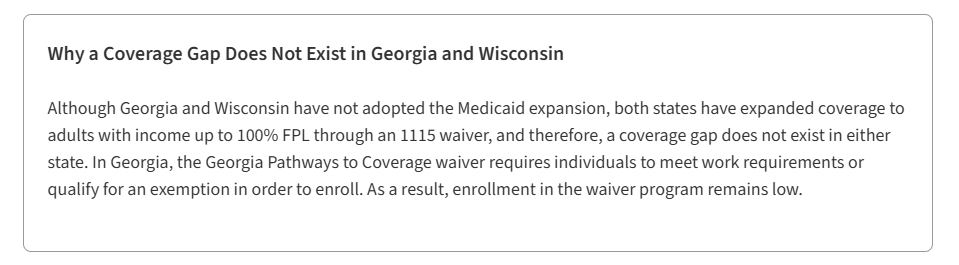
More broadly, policy changes in the 2025 reconciliation law and the expiration of enhanced Marketplace premium tax credits are expected to increase the number of uninsured people who do not fall in the coverage gap. Starting in January 2027, or earlier at state option, the 2025 reconciliation law requires all expansion states along with Georgia, Tennessee, and Wisconsin to condition Medicaid eligibility for individuals eligible through the expansion or waiver program on meeting work requirements. This new requirement is expected to result in significant coverage loss among expansion adults, with the Congressional Budget Office estimating that Medicaid work requirements will increase the number of uninsured individuals by 5.3 million over the next ten years. Yet these coverage losses will not increase the number of people in the coverage gap because adults who lose Medicaid because they do not meet or report work requirements continue to remain eligible for the program based on their income even if they lose Medicaid and become uninsured.
Using data from 2024, this brief estimates the number and characteristics of uninsured individuals in the ten non-expansion states who could gain coverage if Medicaid expansion were adopted.
How many people are in the coverage gap?
The coverage gap exists because not all states have adopted the ACA’s Medicaid expansion. The expansion extended Medicaid eligibility to adults ages 19-64 with incomes at or below 138% the federal poverty level (FPL), or $22,025 for an individual in 2026. Medicaid expansion covers both parents and adults without dependent children—who were previously not eligible for Medicaid. The “coverage gap” occurred because a 2012 Supreme Court ruling made Medicaid expansion optional for states, rather than the nationwide requirement Congress originally intended.
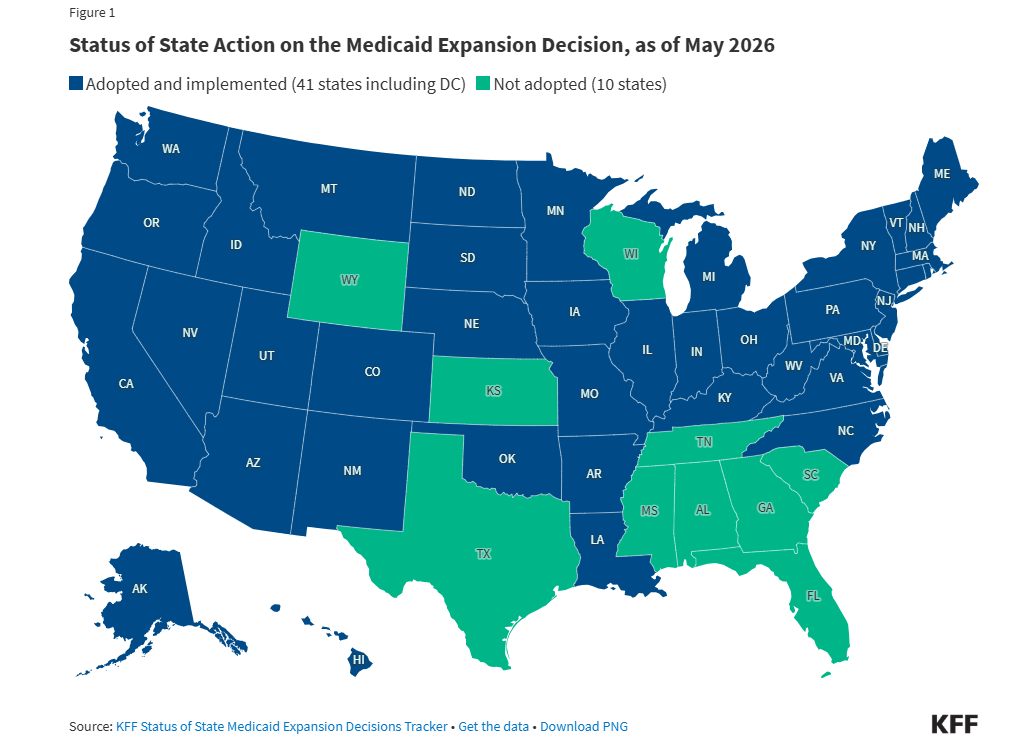
Among the ten states that have yet to adopt Medicaid expansion, an estimated 1.2 million adults fall into the coverage gap because they earn too much to qualify for their state’s Medicaid program but not enough to access ACA Marketplace subsidies (Figure 2). Because the Medicaid expansion was intended to be mandatory for all states with Marketplace coverage available for individuals above the Medicaid limit, the minimum eligibility level for subsidies in the Marketplace was set at 100% FPL. When expanding Medicaid effectively became optional, poor adults living in states that decided not to expand were left without an affordable coverage option.
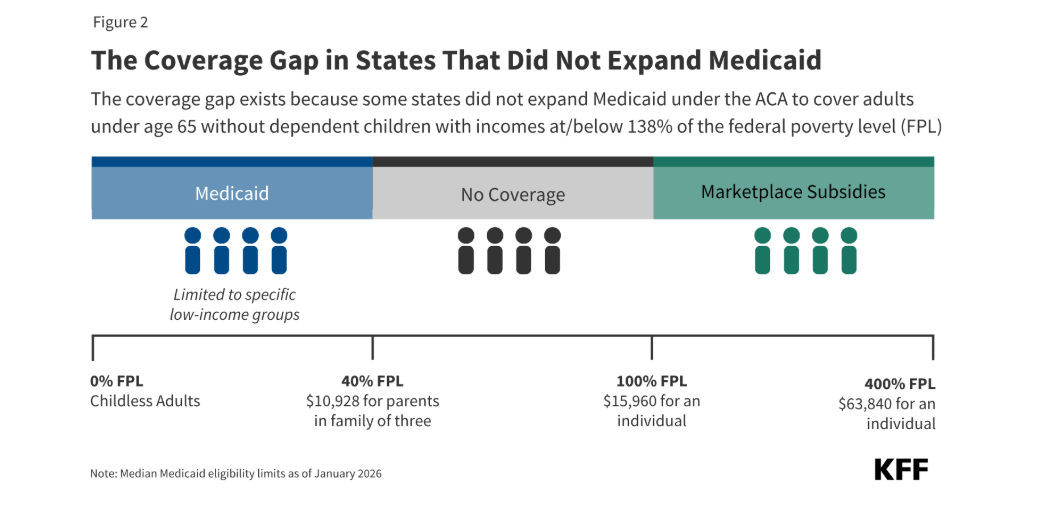
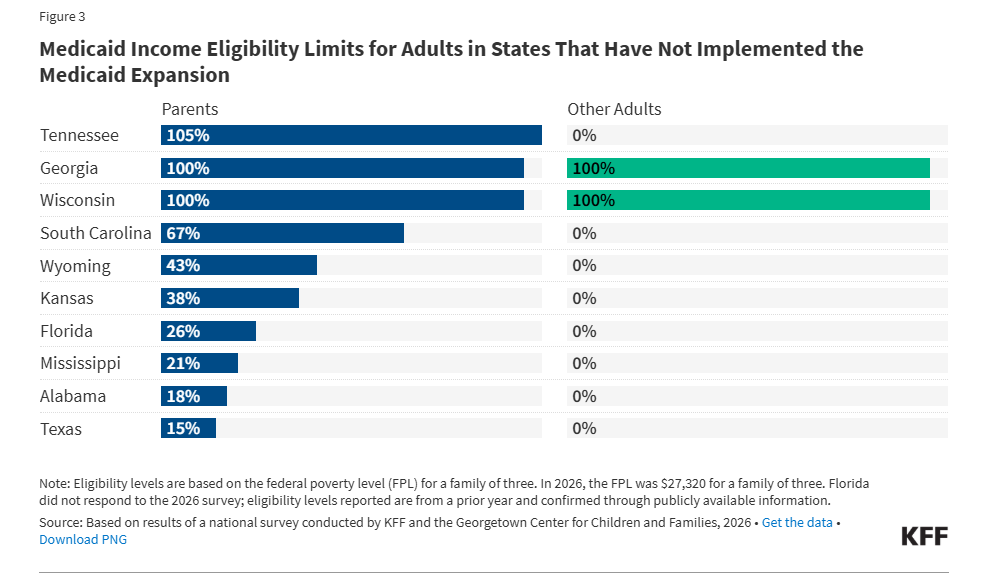
In states that have not expanded Medicaid, eligibility remains limited. The median income limit for parents is 40% FPL in these states, which is $10,928 per year for a family of three in 2026. Texas has the nation’s lowest eligibility threshold for parents at 15% FPL and bars Medicaid access for parents in a family of three earning more than $4,098, or $342 per month. With the exception of Wisconsin and Georgia, which offer coverage though a waiver, non-expansion states do not provide Medicaid coverage to adults under age 65 without dependent children, regardless of income, unless they qualify on the basis of disability (Figure 3). As a result, 78% of adults in the coverage gap are adults without dependent children.
States that have not expanded Medicaid have uninsured rates nearly twice as high as states that have expanded Medicaid (14.5% vs 8.0%). Adults who are uninsured have a harder time accessing care. In 2024, nearly four in ten adults (39%) without health insurance reported delaying or forgoing health care, including physical and mental health services and prescription medication, due to cost compared to 17% of adults with insurance. Uninsured individuals are also less likely than those with insurance to receive services to treat chronic conditions.
Who is in the coverage gap and how many people could gain coverage if all states expanded Medicaid?
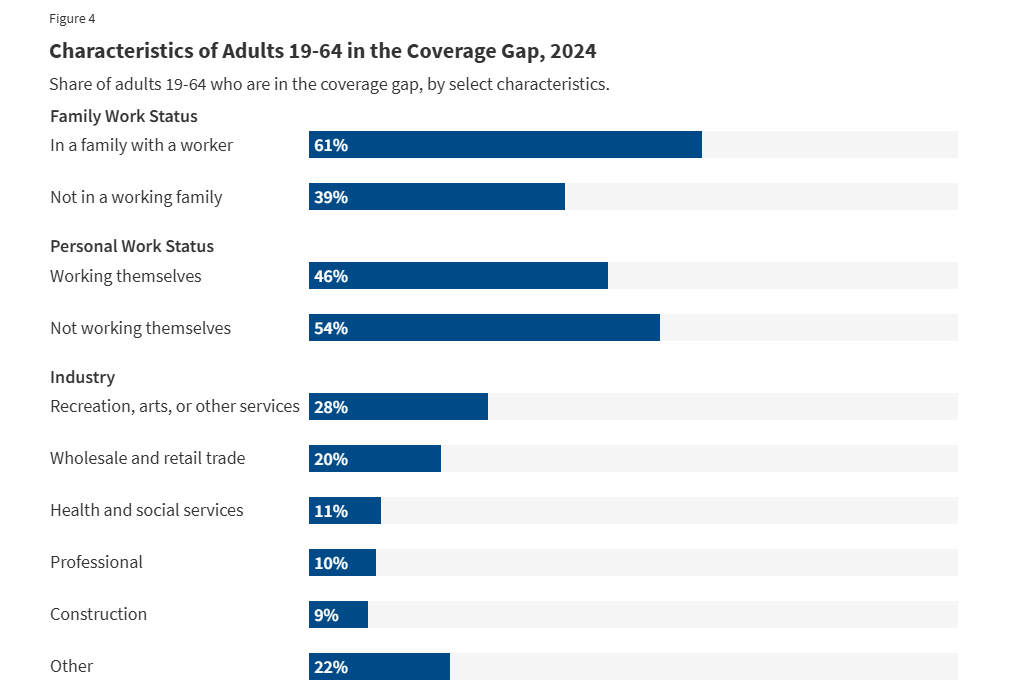
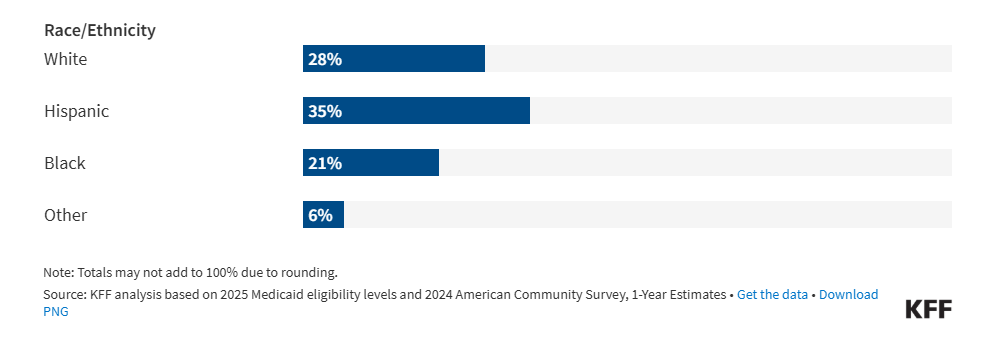
Most adults in the coverage gap work or live with someone who works, and they are disproportionately people of color. Six in ten adults in the coverage gap live in a family with a worker, and over four in ten are working themselves (Figure 4). Many are employed in low-wage jobs and often work for employers that do not offer affordable job-based coverage. Over half of workers in the coverage gap (58%) are employed in the service, retail, and construction industries, with common occupations including cashiers, servers, cooks, constructions labors, housekeepers, retails salespeople, and janitors. Because Medicaid eligibility levels for parents are so low in non-expansion states, even part-time work can make them ineligible. Additionally, Hispanic and Black adults make up over half (56%) of people in the coverage gap.
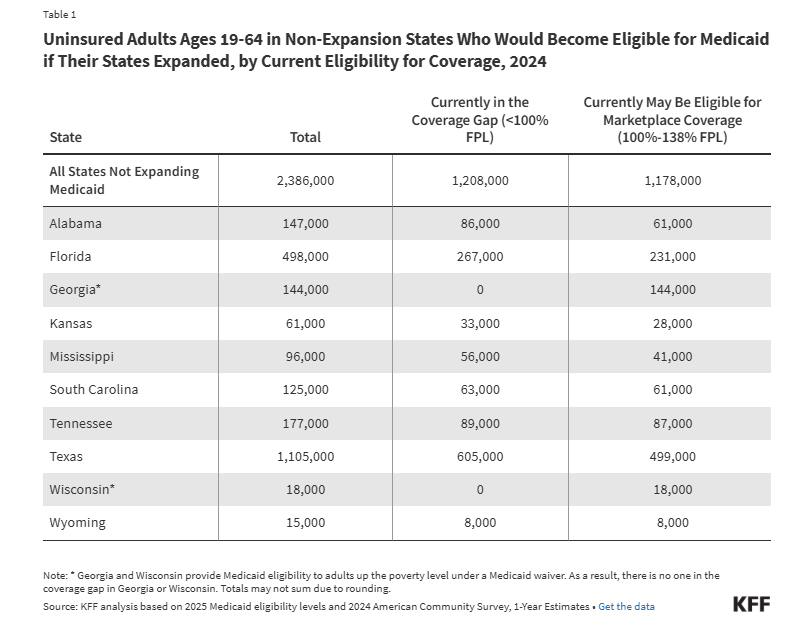
If all remaining states adopted Medicaid expansion, approximately 2.4 million uninsured adults would become eligible for Medicaid. This includes 1.2 million in the coverage gap, who currently have no affordable coverage option, and 1.2 million with incomes between 100% and 138% of the FPL, who are eligible for but not enrolled in Marketplace coverage (Figure 5). For adults eligible for Marketplace coverage, Medicaid would offer an affordable alternative, generally with more comprehensive benefits and lower out-of-pocket costs. While some uninsured adults who are eligible for but not enrolled in Marketplace coverage could qualify for zero- or low-premium Marketplace coverage, the expiration of the temporary enhanced premium tax credits at the end of 2025 increased premiums for most Marketplace enrollees, and fewer adults are now eligible for zero-premium plans.
How will changes in the 2025 reconciliation law affect the overall uninsured population?
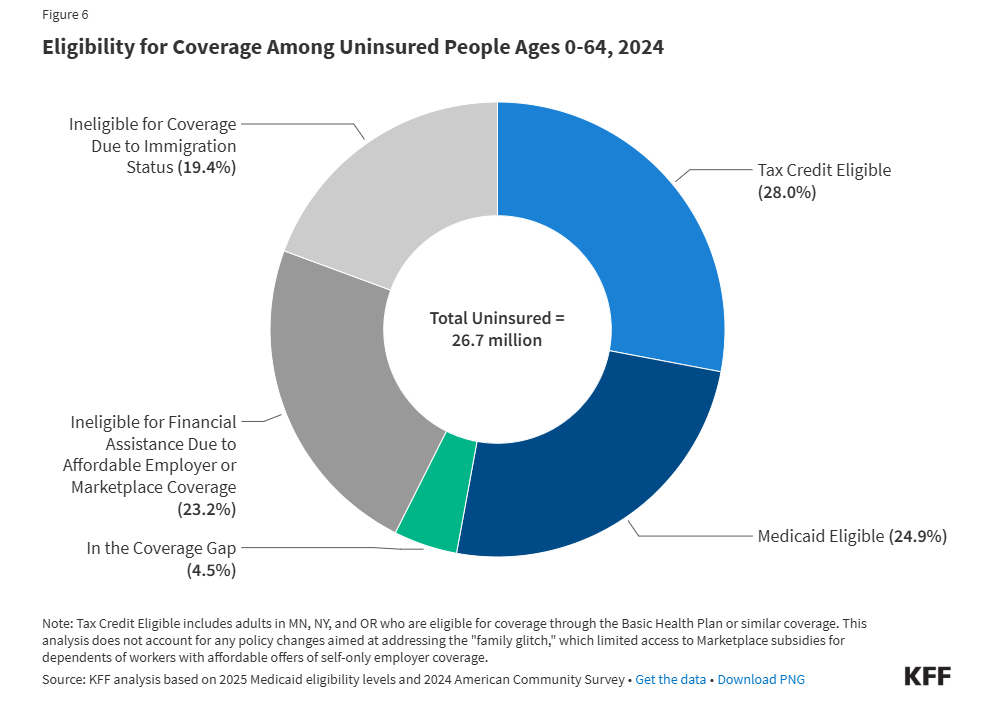
Adults in the coverage gap represent a small share (4.5%) of the 26.7 million people ages 0-64 who were uninsured in 2024 (Figure 6). In the coming years, the number of adults in the coverage gap is unlikely to change substantially; however, the number of uninsured people overall is expected to increase. The Congressional Budget Office has estimated that Medicaid and Marketplace policy changes in the 2025 reconciliation law, most notably new Medicaid work requirements for adults enrolled in the Medicaid expansion, along with the expiration of the Marketplace enhanced premium tax credits, will increase the number of people who are uninsured by 14 million over the next decade. While some of the individuals who become uninsured will no longer be eligible for Medicaid or Marketplace coverage, others remain eligible but will lose coverage because they cannot meet work reporting requirements or are no longer able to afford their Marketplace premium.