
Map Shows Which States Could See Biggest Medicaid Cuts by 2028
By Aliss Higham / August 5, 2026
California and New York could experience the largest numerical declines in Medicaid expansion enrollment under new federal work requirements and more frequent eligibility checks, according to projections from the Urban Institute.
Under an intermediate implementation scenario, researchers estimate that average monthly Medicaid expansion enrollment nationwide could be almost 8 million lower in 2028 than it would have been without the two policies.
The size of the decline is expected to vary significantly among states, depending partly on their populations and ability to verify that recipients are working or qualify for exemptions.
Sweeping changes to the Medicaid expansion, also commonly known as Obamacare, were mandated by the One Big Beautiful Bill Act, the wide-ranging budget law that President Donald Trump signed in July 2025.
What the New Medicaid Rules Require
Adults covered through Medicaid expansion in 41 participating states will generally have to complete at least 80 hours of approved activities each month. The policy applies primarily to expansion recipients ages 19 to 64 who are not eligible for or currently enrolled in Medicare.
Paid employment can count toward the monthly requirement, as can community service, participation in an approved employment program or attendance in an educational program at least part time. Recipients can also combine activities to reach the 80-hour threshold.
States have until January 1, 2027, to introduce the requirements, although Montana and Nebraska have chosen to begin months earlier.
The policy contains exemptions for certain groups, including pregnant people, former foster youth, American Indians and Alaska Natives, totally disabled veterans, and people participating in drug or alcohol treatment programs.
Parents and caregivers responsible for a child age 13 or younger are also exempt, as are people caring for someone with a disability. Other exemptions cover people considered medically frail, those whose health substantially limits their ability to comply and certain recipients already subject to work rules through the Supplemental Nutrition Assistance Program or Temporary Assistance for Needy Families.
The law also requires states to reassess Medicaid expansion recipients' eligibility every six months, instead of generally once a year. Those reviews determine whether recipients still meet income and other eligibility rules. The Urban Institute estimated that the six-month reviews alone could reduce average monthly enrollment by as much as 3.1 million under its medium scenario, before the additional effect of the work requirements.
Republicans have defended the requirements as a way to encourage employment and preserve Medicaid for vulnerable recipients.
"The Working Families Tax Cut legislation made historic changes to the Medicaid program, and CMS is working closely with states to put those changes into action," Dr. Mehmet Oz, the head of the Centers for Medicaid and Medicare Services, said in a June news release. "This rule helps Americans build skills and independence through work, education, job training, or community service, creating new opportunities for themselves and their families."
Which States Could Lose the Most Recipients?
California is projected to record by far the largest numerical reduction under the Urban Institute's medium mitigation scenario, with almost 2 million fewer people enrolled in Medicaid expansion coverage during an average month in 2028.
New York follows with an estimated decline of 955,000 enrollees. Illinois could lose 324,000, while Michigan and Ohio are projected to experience reductions of 287,000 and 285,000, respectively.
Other states facing some of the largest numerical declines include Pennsylvania at 276,000, Virginia at 269,000, Washington at 260,000, North Carolina at 249,000 and New Jersey, at 242,000.
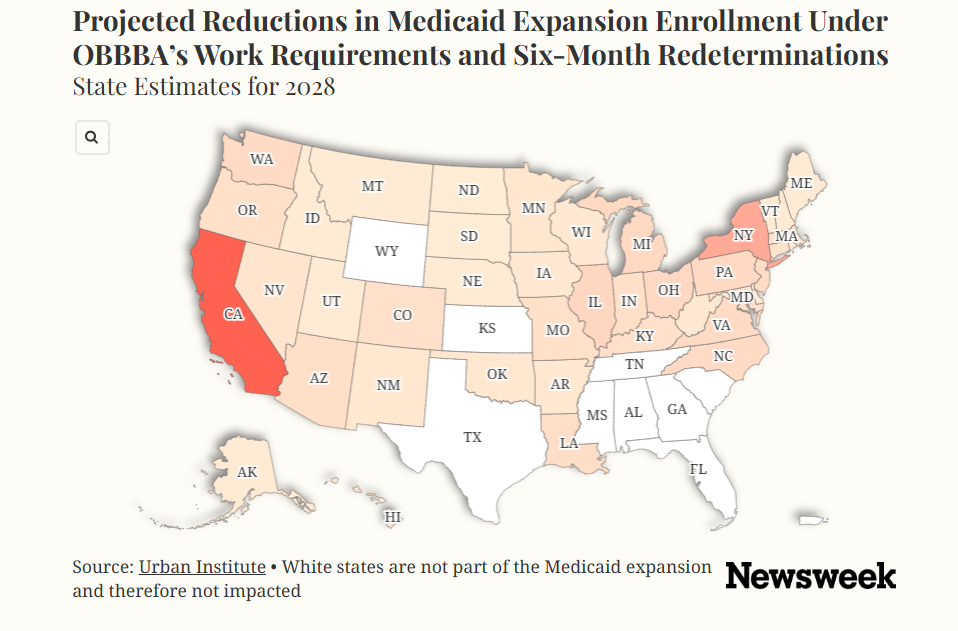
The rankings look different when losses are measured as a share of each state's affected enrollment. Massachusetts faces the largest proportional reduction under the medium scenario, with enrollment projected to fall by 54 percent. Connecticut and Maryland could each experience declines of 51 percent, while Vermont could lose 50 percent and Minnesota 49 percent.
North Dakota has the smallest projected percentage decline, at 30 percent. Oregon and South Dakota follow at 34 percent, while Indiana and Nebraska are each projected to see enrollment fall by 35 percent. Overall, the estimated state-level reductions range from 30 to 54 percent under the medium scenario.
The figures represent declines in average monthly enrollment, rather than the number of distinct people who might lose coverage at some point during the year.
Eligible Adults Could Still Lose Coverage
The Urban Institute cautioned that some people could lose Medicaid even when they are working enough hours or meet the conditions for an exemption.
Federal law directs states to use information contained in existing government systems to confirm compliance whenever possible. Data matching could, for example, allow a state to verify a recipient's wages or participation in another public assistance program without requiring that person to submit further paperwork, the report said.
But the effectiveness of those systems and the administrative approaches taken by states are expected to differ. People could encounter difficulties reporting irregular work hours, proving self-employment income or documenting a medical condition or caregiving responsibility.
Previous state Medicaid experiments involving work requirements found that data matching helped limit coverage losses. Even so, administrative hurdles are expected to leave some eligible people without insurance.
The researchers identified self-employed people, students, adults between 50 and 64, caregivers for disabled relatives, and people with conditions affecting their ability to work as groups facing a heightened risk.
Losing health insurance can lead people to delay treatment, leave medical needs unmet or take on additional costs. The Urban Institute also noted that disruptions in coverage could create further obstacles to employment, the activity the requirements are intended to encourage.