
Medicaid plans brace for costly role in work requirements
By Nona Tepper / June 17,2026
Health insurance companies that administer Medicaid benefits have been drafted into state efforts to implement work requirements next year.
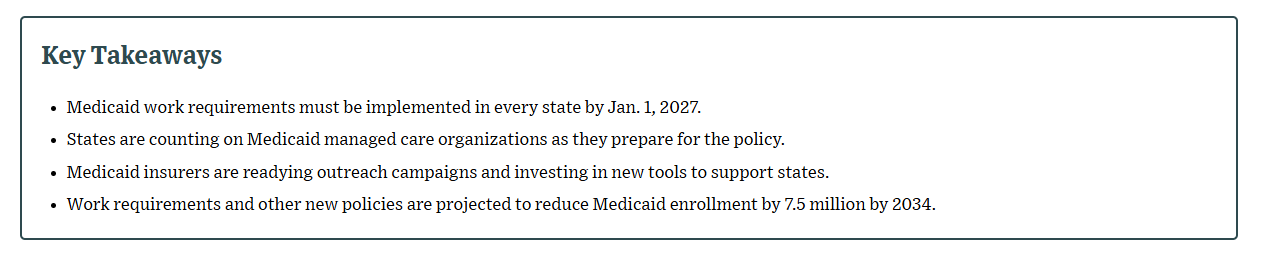
Medicaid managed care organizations such as CalOptima, Colorado Access and UPMC Health Plan are devising marketing campaigns and technology strategies to support state plans to alert Medicaid policyholders about new rules limiting enrollment that take effect by Jan. 1.
These insurers have their work cut out for them as they stand to lose millions of Medicaid members. States have to quickly erect complex systems to carry out President Donald Trump’s tax law, which cut Medicaid funding by nearly $1 trillion. The work requirements rule mandates that most Medicaid enrollees aged 19-65 verify they log at least 80 hours a month of work, school or volunteering as a condition of eligibility.
“This is an expensive and resource-intensive effort on behalf of the state, but also the plans. There are concerns about the financial toll this will take,” said Jennifer Babcock, senior vice president for Medicaid policy at the Association for Community Affiliated Plans. The trade group represents insurance companies such as CareSource and Independence Health Group subsidiary AmeriHealth Caritas that specialize in government health programs.
Medicaid carriers have good reason to help people enroll in and retain their benefits: States pay insurers monthly fees based on how many enrollees they cover, and the nonpartisan Congressional Budget Office projects the work requirements and other Medicaid provisions in the tax law will force 7.5 million people off the program by 2034.
“For plans like ours, it has been a huge business shift,” said Liz Owens, chief external relations officer for Colorado Access. “All of a sudden, this is all we are working on.”
Health insurance companies are not permitted to participate in verifying Medicaid eligibility but they can complement states’ public outreach campaigns and technology infrastructure and share claims data to substantiate exemptions from work requirements, such as a medically frail designation.
“Medicaid enrollees are a notoriously difficult population to communicate with,” said Spencer Perlman, managing partner and director of healthcare research at Veda Partners, which analyzes public policy for investors. “The fact that the [managed care organizations] have this ready-made avenue for communicating with them is something that [the Centers for Medicare and Medicaid Services] wants to be able to tap into.”
Medicaid insurers played a similar role when states resumed eligibility redeterminations in 2023 after the COVID-19 public health emergency. “Unwinding” the pandemic-era continuous coverage policy nevertheless pressured earnings at companies such as Centene and UnitedHealth Group when about 25 million people lost coverage, which was far more than expected.
Insurance companies again find themselves helping to implement policies that will reduce their memberships, said CalOptima Chief Operating Officer Yunkyung Kim.
CalOptima, owned by Orange County, California, has earmarked $20 million for activities to support work requirements implementation, Kim said. That includes dipping into its reserves to pay overtime to the Orange County Social Services Agency employees who will attend community events and verify members’ eligibility, she said. CalOptima is also setting up a telephone hotline that will connect its 835,000 Medicaid members to county staff, she said.
“Every handoff that we can reduce means that we close these gaps faster,” Kim said. “The county’s systems and their budgets are very much stressed right now, and what we don’t want to find is that there aren’t enough resources to do this.”
Colorado Access is meeting monthly with state officials to discuss its marketing plans, Owens said. The nonprofit insurer is forwarding state eligibility notifications to members and partnered with the nonprofit Center to Advance Consumer Participation to develop an advertising campaign, she said.
The nonprofit insurer is devising a targeted marketing campaign and outreach to providers based on assessments of what members are at risk of losing coverage, where they are located and what their health status is, Owens said.
UPMC Health Plan is waiting for clarity on whether Medicaid members who take part in its Pathways to Work program would be deemed complaint with work requirements, said Brendan Harris, president of Medicaid and state programs division.
Pathways to Work gives UPMC’s 1.8 million Medicaid enrollees an opportunity to get jobs at its parent company, the University of Pittsburgh Medical Center. If they are hired, they move into the nonprofit health system’s employee health plan.