
States must pivot on Medicaid work requirements after CMS rule
By Bridget Early / June 16, 2026
The race is on for states to iron out their Medicaid work requirement plans and tie up loose ends for providers, insurers and beneficiaries.
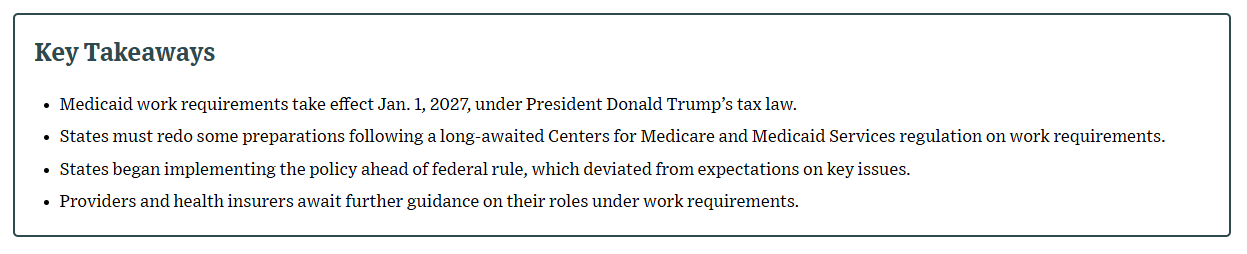
The Centers for Medicare and Medicaid Services issued a long-awaited regulation this month laying out federal standards for work requirements. But states facing down a Jan. 1, 2027, deadline to have the system running will have to quickly rethink their strategies because CMS caught them by surprise on key issues.
States, health insurance companies, providers, enrollees and other stakeholders have less than six months to implement the biggest change to Medicaid since the Affordable Care Act of 2010 expansion. For policies this complex, that’s no time at all.
“There is still a phenomenal amount of work and preparation and coordination that needs to take place if this is absolutely going to go live on Jan. 1,” said Ceci Connolly, president and CEO of the Alliance of Community Health Plans, which represents provider-affiliated insurance companies such as Oakland, California-based Kaiser Permanente and Danville, Pennsylvania-based Geisinger Health.
States are already hustling to figure out work requirements, but the new rule “will make it much harder” to carry out the program, a spokesperson for the Pennsylvania Department of Human Services wrote in an email. “What CMS released earlier this month differs significantly from its previous general guidance and will create significant administrative and resource burdens,” the spokesperson wrote.
The work requirements policy applies in 40 states and the District of Columbia, which expanded eligibility under the Affordable Care Act of 2010, and in Georgia and Wisconsin, which implemented narrower expansions. In those states, enrollees aged 19-65 have to document that they spend at least 80 hours a month working, schooling or volunteering. Some categories of enrollee are exempt, such as pregnant people, parents of young children and people with disabilities.
States are assessing CMS’ interim final rule and determining what gaps exist between the preparation they made ahead of time and what CMS now requires, said Kinda Serafi, a partner at the law and lobbying firm Manatt, Phelps & Phillips. Serafi advises states and healthcare clients on Medicaid.
In the next few weeks, states and their technology vendors will need to determine whether their eligibility and enrollment systems are capable of managing the new requirements, Serafi said. They’ll also have to convene with healthcare stakeholders, determine whether to make formal comments on the rule, assess whether it’s possible to meet the January deadline and decide whether to ask CMS for extensions, she said.
That’s all before states get down to the brass tacks of resetting their strategies, revising notices to enrollees, rewriting Medicaid applications and changing technology workflows, Serafi said.
Most states won’t be ready in time, Serafi predicted.
Providers
Providers need information from states on what billing codes might qualify an enrollee as medically frail, and thus exempt from work requirements, and how providers are expected to document that.
Once states have provided clearer guidance, providers will need to determine which patients might qualify for exemptions, said Darryl Drevna, senior director of regulatory affairs for the American Medical Group Association, which represents integrated health systems and multispecialty medical groups such as Ohio-based Cleveland Clinic and Arlington, Virginia-based Privia Medical Group.
Providers will then need to work with their electronic health vendors to make it possible to document medical frailty, then build that into their workflows, which will entail training clinicians and staff members, Drevna said.
A standardized form for attesting medical frailty would be helpful, especially for providers that operate in multiple states, Drevna said. “The more variation that is part of this process, the harder it’s going to be, and the more folks who are going to slip through the cracks,” he said.
Health insurance companies
Medicaid managed care organizations, which are precluded from direct involvement with eligibility determinations, can still help with education and outreach to Medicaid members.
But insurers clarity to smooth implementation, and this rule provides the opposite, said Emma Liebman, associate director of policy for the Alliance of Community Health Plans. For instance, questions remain about the medical frailty designation and about how states will handle beneficiary self-attestation to prove compliance or exemption.
Technology companies
Technology vendors need to adapt quickly once they receive information from states that could necessitate systems changes, said Verlon Johnson, chief government and corporate affairs officer for the healthcare technology company Acentra Health.